
The teres minor (L. teres, round and long ; minor, smaller.) is a small rotator cuff muscle, which is hidden from the surface of the physique.
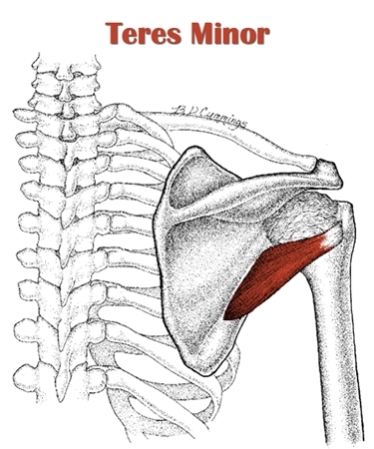
It acts on the shoulder joint and is a prime mover (along with the infraspinatus) in shoulder external rotation. Like all rotator cuff muscles, it also helps stabilize the humeral head in the shoulder socket.
Note: In some contexts, it can be practical to consider the teres minor and infraspinatus to be one muscle, since they so similar in both function and location. Their fibers run parallel to each other and in some cases are actually fused together, making it difficult to tell them apart.
Categorized as part of the scapulohumeral (intrinsic shoulder) muscle group, the teres minor is situated inferior to the infraspinatus, superior to the teres major and deep to the deltoid.
The teres minor originates from the lateral border of the posterior scapula. Its fibers run superolaterally in a parallel orientation and converge as they insert on the greater tubercle, forming a radiate muscle shape.
Table of Contents
Also Called
- Rotator cuff
- External rotator
Origin, Insertion, Action & Nerve Supply
| Muscle | Teres Minor |
|---|---|
| Origin | Middle to upper portion of the lateral border of the scapula, on its posterior surface |
| Insertion | Inferior facet of the greater tubercle of the humerus |
| Action |
|
| Nerve Supply | Axillary nerve (C5-C6) |
Exercises:
Note: The lists below only include exercises that train the teres minor directly, meaning that external rotation is a major (if not the only) action in the movement. Exercises that train the teres minor indirectly include any clean, snatch or pull Olympic lift variation, as well as rear deltoid exercises and many lat exercises.
The following exercises are the exact same ones that train the infraspinatus.
Barbell Exercises:
- Cuban rotation
- Cuban press
Dumbbell Exercises:
- Standing upright shoulder external rotation
- Seated upright shoulder external rotation
- Standing upright supported shoulder external rotation
- Seated knee-supported shoulder external rotation (90° shoulder flexion)
- Side lying shoulder external rotation
- Prone shoulder external rotation
- Incline shoulder external rotation
- Incline side lying shoulder external rotation
- Incline row to external rotation
- Unilateral YTL
- YTWL
Cable Exercises:
- Standing shoulder external rotation
- Seated shoulder external rotation
- Standing shoulder external rotation
- Seated shoulder external rotation
- Face pull with external rotation
Machine Exercises:
- Shoulder external rotation
- Upright shoulder external rotation
Bodyweight Exercises:
- Prone shoulder external rotation
- Incline shoulder external rotation
- Incline row to external rotation
- Unilateral YTL
- YTWL
- Scapular wall slide
- Side lying extension-rotation
- Side lying internal-external rotation
- Side lying windmill
Stretches & Myofascial Release Techniques:
Stretches
The following teres minor stretches are the same as the infraspinatus stretches.
- Side lying teres minor stretch (aka sleeper stretch)
- Broomstick infraspinatus stretch
- Bent over infraspinatus stretch
- Seated bent over infraspinatus stretch
- Side lying infraspinatus stretch
Self Myofascial Release Techniques
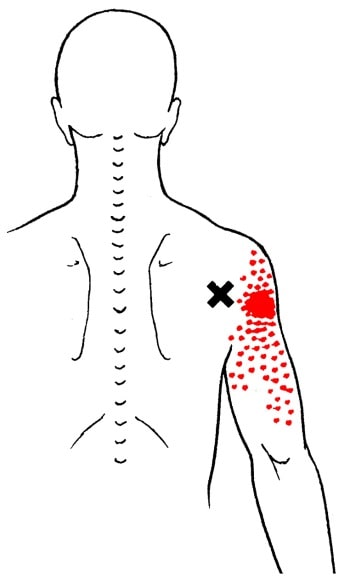
When using these techniques, give special attention to the trigger point shown in the image below.
Tool
- Lacrosse ball
- Backnobber II
Common Issues:
- Inhibited/Lengthened Teres Minor: The teres minor is inhibited and lengthened in individuals with upper crossed syndrome (UCS). The shoulder internal rotation that is a hallmark of UCS, causes the teres minor and other external rotators to be in an inhibited and chronically stretched state. The source of the internal rotation is typically the result of poor postural habits and overuse of the chest, lats and other internal rotators, causing them to be in an overactive and shortened state.
Training Notes:
- If your teres minor is inhibited/lengthened, do the following:
- Increase training volume on exercises that isolate the movement of shoulder external rotation (e.g. prone external rotation, dumbbell side-lying external rotation). Start with 3 main sets, 3-4 times per week and never go to failure.
- If you perform these on workouts where you’re doing compound upper body push or pull exercises, do the main sets after your compound upper body exercises. However, you can also warm up with 1-2 sets before the compound exercises with less weight or fewer reps than your main sets – this way, you activate the muscle without fatiguing it.
- Increase training volume on exercises that integrate shoulder external rotation with dynamic scapular stability (e.g. face pull with external rotation, unilateral YTL, incline row to external rotation).
- Increase training volume on rear deltoid exercises, which typically involve horizontal abduction. Since the teres minor assists in shoulder horizontal abduction, it will also be strengthened. Furthermore, since the rear delt is also an external rotator, these exercises will improve overall strength of the external rotators relative to the internal rotators.
- Use lighter weight and moderate to high reps (8-15) for the exercises mentioned in the three bullet points, above.
- Reduce training volume on exercises that emphasize the larger internal rotator muscles, namely, chest exercises and lat exercises.
- In case you’re asking, “Why should I do fewer lat exercises? They involve shoulder adduction, which is an action of the teres minor.” The answer is simple: the lat is a much more powerful as an internal rotator than the teres minor is as an adductor.
- Although your objective is to do more training volume for external rotation and less for internal rotation, it may actually be beneficial to include a few sets of an isolation internal rotation exercise. Why? To target the subscapularis, because, in some cases at least, it is inhibited by the large internal rotators. So, training it while also doing external rotation work, will help balance the rotator cuff musculature and improve shoulder stability. I’ve had good results with the prone arm-supported internal rotation.
- Release and stretch the internal rotators before workouts involving upper body exercises or lower body exercises where the bar is on your back. Ideally, you should also release/stretch these muscles as part of a daily mobility routine. The goal is to inhibit and lengthen these overactive and short muscles, in order to activate the external rotators and improve external rotation range of motion – both acutely before training, and long-term.
- It may be necessary to use release techniques on the rear deltoids (but don’t stretch them). Although the external rotators, as a group, are weaker than the internal rotators, the rear delt will sometimes become overactive to compensate for the teres minor and infraspinatus. As a result, it can get tight and knotted up with trigger points; if left unchecked, this can actually keep the teres minor and infraspinatus inhibited. My favorite rear delt release technique is to lie down pin a lacrosse ball between the muscle and the floor, applying pressure on tender spot(s).
- Minimize the amount of time you spend in postures that put your shoulders in internal rotation. Common activities that place your shoulders in this position include playing video games, typing on a computer, using your smartphone, etc. When you’re in a bad posture for a prolonged period, take a brief break every 20 minutes to stretch out and move around, or at the very least modify your position.
- The above bullet points provide a good starting point for fixing the teres minor dysfunction. However, upper crossed syndrome is often the underlying problem, which must be addressed to achieve a permanent result. Assuming this is the case in your situation, refer to how to fix upper crossed syndrome (article coming soon).
- Increase training volume on exercises that isolate the movement of shoulder external rotation (e.g. prone external rotation, dumbbell side-lying external rotation). Start with 3 main sets, 3-4 times per week and never go to failure.
- If you don’t have any teres minor issues – or other rotator cuff issues for that matter – you should still do some maintenance rotator cuff work. Perform 2-4 sets of external rotations and internal rotations, 1-3 times per week using light weight and high reps (approx. 12-20 reps per set).
- The following is general advice on proper technique for teres minor exercises:
- Some external rotation exercises are more technical than others. Start with the exercises that are easiest to perform correctly so that you actually train the target muscles (i.e. supported upright external rotation variation, dumbbell prone or side lying external rotation variations). Once you master these movements, you can try the more technically challenging ones (i.e. non-supported upright external rotation variations, cable external rotation variations).
- For dumbbell side lying external rotation variations, put some kind of padding (e.g. rolled-up towel, squat pad) between your arm and torso so that your arm is slightly abducted. This position is more conducive to teres minor/infraspinatus activation. And it prevents the upper arm from moving around, which keeps the humeral head centered in the shoulder socket.
Related Muscles
The other three rotator cuff muscles:
Hey Alex, thanks for writing this article- I learned a lot about the teres minor.
The reason I ended up on this article was actually because I just finished a bench workout with a lot of sets working pretty close to failure on each one. After I finished, I realized that the back of my shoulders were really sore. Certain positions produced a pretty acute pain.
It looks to me like the location is the teres minor but I don’t understand why I would have teres minor pain because 1. I’ve been doing a lot of posterior delt work for a while now and compared to the rest of my physique and strength I’d say they’re pretty well developed and 2. I’m keeping my shoulders back and down when I bench and my form is solid.
I also warmed up properly pyramiding up in weight for the bench and between my warmup sets I was doing very low intensity rear delt raises to get a little pump in the area. Basically, I feel like I’m doing everything by the book so I don’t understand why the back of my shoulders are so cranky right now!
If you end up reading this long diatribe and responding, I really appreciate it. Have a good one.
Interesting. I wouldn’t expect that given the exercise and the warm up. How’s the bench width? Are your shoulders starting to overhang over the side (i.e. less support)? If so, MAYBE that could have contributed. Ever since I got my new bench (12″ width pad), I haven’t had any shoulder tweaks–front or back.
It could just be that the muscle was going to tweak sooner or later, and bench just happened to be the exercise that it did it on.
Also, maybe it’s not actually the teres minor, but rather referral pain from a different muscle. Or possibly a shoulder capsule issue. It’s impossible to guess.
In any case, you should go light on, or avoid anything that aggravates the area.
If it doesn’t cause any issues, some light soft tissue work can help, too. Before training and when you have time at home. Just don’t go crazy on it. Some light direct rotator cuff is often helpful, too (both internal and external rotations; whichever variation you prefer)…just make sure your form is correct.
Hope this points you in the right direction.
Did you ever find out the cause and fix this issue? I’m dealing with the exact same thing.